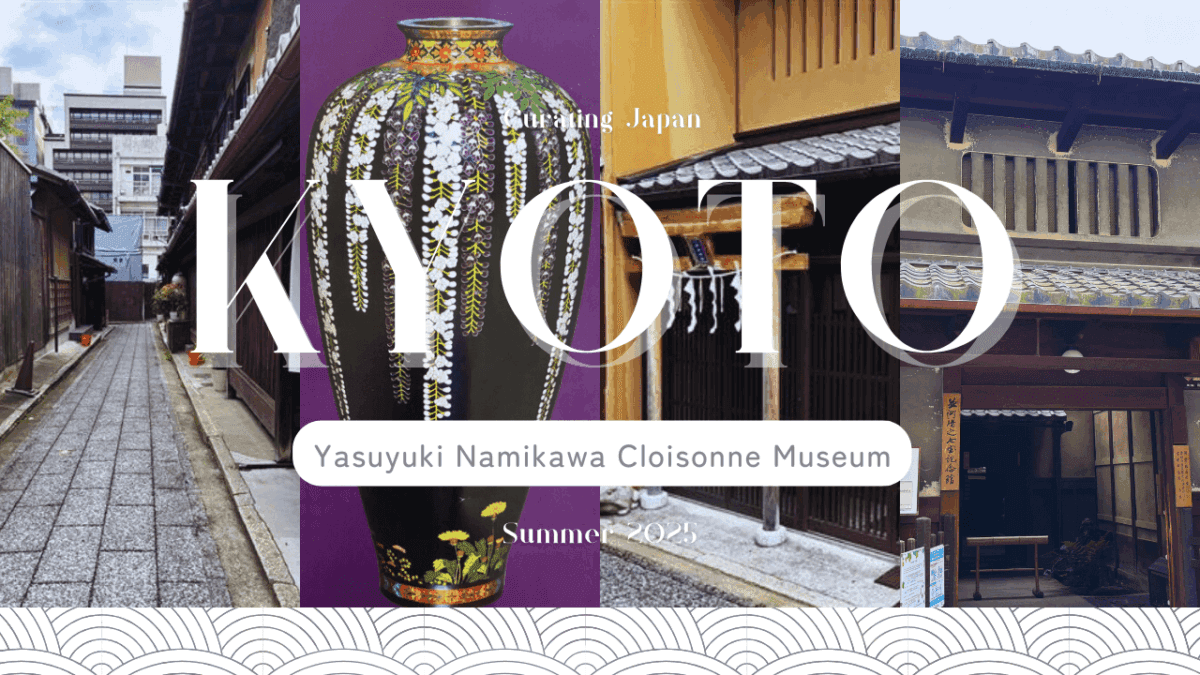
Discover the Yasuyuki Namikawa Cloisonne Museum in Kyoto, showcasing Yasuyuki’s cloisonné masterpieces and a stunning Ogawa Jihei garden. Learn history, join a workshop, and explore Japanese aesthetics.
Tucked away on a quiet street in Kyoto’s Okazaki area, the Namikawa Yasuyuki Cloisonné Museum offers a rare chance to step inside the former residence and workshop of one of Japan’s most celebrated cloisonné artists, Namikawa Yasuyuki.
Over 130 works by Namikawa are held in the Victoria and Albert Museum (V&A) in London, showcasing the exquisite skill he perfected. Here, his masterpieces are displayed in harmony with a breathtaking garden designed by Japan’s legendary 7th-generation garden master Ogawa Jihei. This is truly a space where the essence of Japanese aesthetics comes to life.
What is Cloisonné? — Japan’s Enamel Art Tradition

Cloisonné is an ancient technique in which a glassy enamel glaze is fired onto the surface of metal. Its history stretches back to around 1500 BCE in ancient Egypt. The art later flourished in Byzantine and medieval Europe, often adorning church interiors—stained glass windows, in fact, are a form of cloisonné.
The craft was introduced to Japan along with Buddhism in the Asuka–Nara period (6th–8th centuries). Artifacts at Hōryū-ji Temple still bear traces of these early cloisonné techniques.
The Life and Art of Yasuyuki Namikawa
Born into a samurai family in Kyoto, Namikawa began his career as an attendant to the Imperial family before dedicating himself entirely to cloisonné.
He mastered the yūsen shippo (“wired cloisonné”) technique, in which thin metal wires separate different enamel colors, and later developed the famous “Namikawa Black”—a deep, transparent black glaze.
This unique style, with its delicate patterns on lustrous black enamel, won worldwide acclaim. From the 1876 Philadelphia Centennial Exposition to the 1900 Paris Exposition (where he received the Grand Prix), Namikawa’s works earned numerous international awards. In 1896, he was appointed an Imperial Household Artist and continued to work exclusively in cloisonné until closing his workshop in 1919.
Inside the Yasuyuki Namikawa Cloisonne Museum
The museum building is a fine example of the Omoteya-zukuri style typical of merchant houses, with separate “mise” (shop) and “ie” (living quarters) connected by an entrance hall. Original features such as the earthen-floored kitchen remain intact. The building is a Registered Tangible Cultural Property and a Kyoto City Designated Historical Building.
And the garden – it is also wonderful.

Ogawa Jihei’s Garden — A Living Masterpiece
The garden is a masterpiece by 7th-generation Ogawa Jihei (Ueji), known as the father of modern Japanese gardens. It draws water from the nearby Lake Biwa Canal, creating a soothing stream and sound. Through skillful use of shakkei(borrowed scenery), the garden achieves an extraordinary sense of depth.Ogawa Jihei’s other renowned works include Murinan (which borrows the mountains of Nanzen-ji Temple), the gardens of Heian Shrine, Tokyo’s Former Furukawa Gardens, and Chinzanso Garden. His 11th-generation descendant continues the family’s garden-making legacy today.
Hands-On Cloisonné Jewelry Workshop in Kyoto
On select days, you may be able to take part in a cloisonné jewelry-making workshop within this inspiring setting.
- Duration: approx. 3 hours
- Fee: about ¥3,000
- Activity: Create a cloisonné accessory, such as a butterfly motif
- Participants: From 1 person; advance reservation required
Plan Your Visit — Access & Information (check before visiting)
| Items | Details |
|---|---|
| name | Namikawa Cloisonné Museum of Kyoto |
| category | Museum |
| Location | 388 Horiike-cho, Sanjo-dori Kitaura, Shirakawa-suji Higashi-iru, Higashiyama-ku, Kyoto, Japan |
| Access | 3-min walk from Exit 1 of Higashiyama Station (Kyoto Subway Tozai Line) / 5-min walk from “Higashiyama Sanjo” bus stop (Kyoto City Bus lines 201, 202, 203, 206). No parking available. |
| Business Hours | Hours: 10:00 – 16:30 (last entry 16:00) |
| regular closing day | Mondays & Thursdays (open if a public holiday, then closed the following day), plus long closures in summer & winter (check in advance) |
| admission fee | Adults: ¥1,000 / Free for high school students and younger, and for holders of a disability certificate |
| Approximate time required | Approx. 1 hours (Workshop: approx. 3 hours) |
| Official Site | https://namikawa-kyoto.jp/ |
| Phone number | 075-752-3277 |
Why Visit Yasuyuki Namikawa Cloisonné Museum in Kyoto?
A wonderful museum where you can see and experience cloisonné art in a beautiful building.
For the latest information, please check the official website. For the latest information, please check the official website.
Want to explore Kyoto more? Check our contents!